

When comparing a conventional diesel Ground Power Unit with an electric GPU, it is easy to focus on the purchase price.
But for equipment operating day after day, the initial investment is only part of the financial picture. Energy, maintenance, and utilization continue to affect costs throughout the equipment’s working life.
That is why Total Cost of Ownership – TCO – matters when evaluating an eGPU fleet.
The real cost builds over time
An eGPU changes two important recurring costs: energy and maintenance.
Instead of diesel fuel, an electric GPU uses electricity. It also has fewer moving parts than a diesel-powered unit, which reduces maintenance costs.
For the ITW GSE 7400 eGPU, a sample calculation based on 5.5 operating hours per day shows a lower TCO than a diesel GPU after two years on average. And over ten years, the same calculation shows more than $390,000 in OPEX savings compared with a diesel unit.
Actual results will vary depending on operating hours, local energy prices, maintenance costs and equipment lifetime. But the example illustrates why purchase price alone does not provide the full picture.

Utilization matters
The more frequently equipment operates, the more important the recurring costs become.
Every operating hour adds energy and maintenance costs, so the business case for an eGPU should reflect the actual operating profile.
How many hours will the GPU operate each day? What are the local energy costs? And how long is the planned equipment lifetime?
Asking these questions provides a stronger basis for comparison than purchase price alone.
More than a financial calculation
Electrification also changes the environment around the aircraft.
The 7400 eGPU produces no direct NOx or CO2 emissions during operation and offers low-noise operation compared with diesel-powered equipment.
For teams working close to the aircraft, replacing a diesel-driven engine with battery-powered ground power therefore also changes the immediate working environment at the gate, on the apron, or in the hangar.

Think about charging as part of the system
Moving to electric GSE also means considering how equipment will be charged and how available electrical capacity can be used effectively.
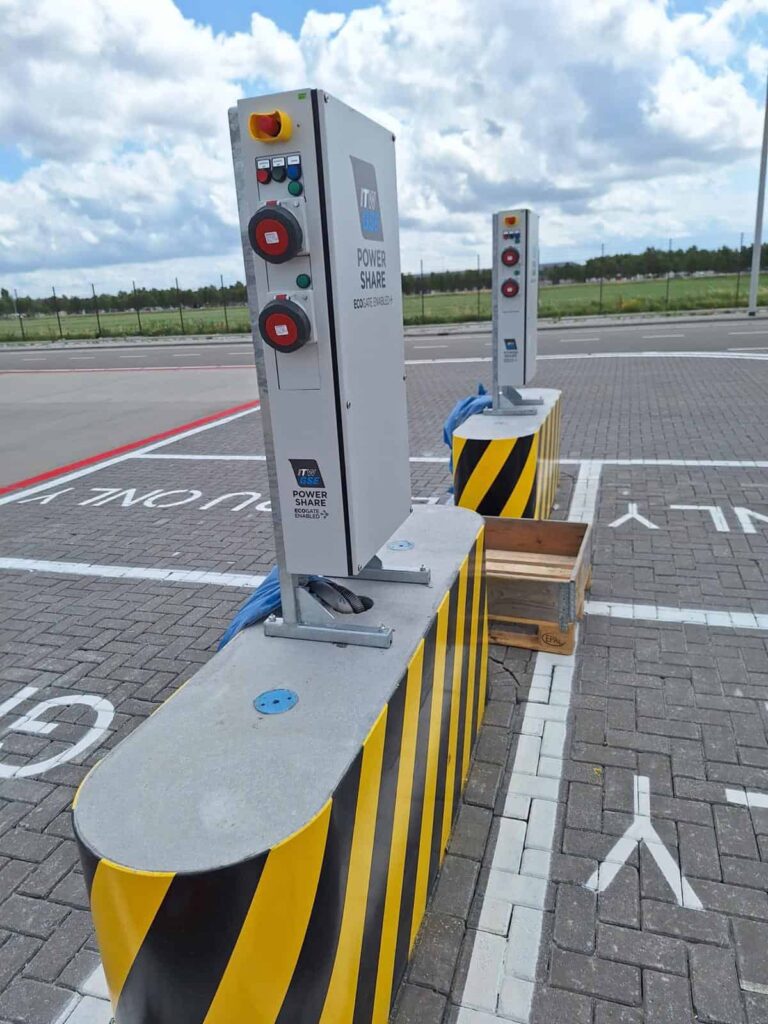
See how ITW GSE Power Share can help make better use of available power at the gate.
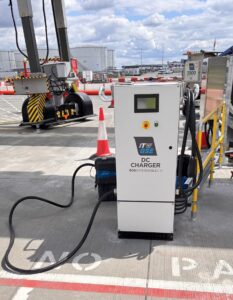
For flexible eGSE charging, explore the ITW GSE DC Charger.
Look beyond the purchase price
The business case for an eGPU is not simply about what the equipment costs on day one.
It is about what it costs to operate throughout its working life.
Energy, maintenance, utilization and equipment lifetime all matter – and together they provide a much clearer picture of the economics of an eGPU fleet.
Want to explore what the numbers could look like for your operation?
Discover the ITW GSE 7400 eGPU and contact us for a calculation based on your operating conditions.