

search success chat linkedin google-plus telephone multimedia youtube linkedin instagram right-arrow mobile-phone
Support
Brochüren Herunterladen
Power by the Hour
preloader

Airport electrification: scaling electric GSE across multiple gates

How to scale electric GSE across multiple gates

To scale electric GSE across multiple gates, airports need to coordinate charging, ground power and PCA as one connected power system. This means prioritizing aircraft-critical functions, distributing available capacity dynamically and avoiding simultaneous peak loads across gates.

Electrification is therefore not only a fleet decision. It depends on how power demand is managed across equipment, gates and operational workflows.

Limited grid capacity, growing charging demand and fragmented equipment usage can quickly turn electrification into operational complexity.

The system-based EcoGate approach helps airports scale electric GSE without compromising turnaround performance, reliability or existing infrastructure.

Overview of electrification challenges

Challenge What it means in practice What to consider first Read more
Limited grid capacity Total demand may exceed available gate-level capacity when
GPU, PCA and charging operate together
Map aircraft-critical loads and
identify flexible charging
windows
Grid capacity

EcoGate

Charging congestion Central charging can create towing, queues and downtime Move charging closer to operations
and use opportunity charging
Charging bottlenecks

DC Charger

Simultaneous PCA, GPU
and charging demand
Peak demand can increase during turnaround Protect aircraft-critical
loads and adjust charging
first
EcoGate

Power Share

Charging challenges

Mixed gate and remote
stand operations
Fixed infrastructure may not cover every operational scenario Combine fixed systems
with mobile electric
equipment
eGPU

PCA 

Uncoordinated rollout Equipment may be underused or create new bottlenecks Start with the biggest
constraint and phase
rollout
EcoGate

Sales team

The challenge of scaling electrification across multiple gates

Electrifying a single gate is manageable. Scaling across an entire terminal is not.

As electric GSE fleets grow, airports typically face three constraints:

  • Limited grid capacity – infrastructure was not designed for simultaneous charging and operation
  • Peak load pressure – multiple units drawing power at the same time
  • Disconnected operations – charging, cooling, and power supply handled separately

The result is predictable: bottlenecks, overload risks, and reduced operational efficiency.

Do we have enough grid capacity to support electrification?

Not always. But in many cases, airports can scale electric GSE further by managing when and where power is used, before investing in major grid upgrades.

Airports can often support electric GSE within existing grid limits by prioritizing aircraft-critical loads first. During turnaround, GPU and PCA demand should be protected, while charging uses remaining available capacity and adjusts when total gate demand increases.

However, the constraint is often not total power — but how it is used.

For a deeper look at infrastructure constraints, see our guide on How Airports Can Electrify Gates Without Expanding Grid Capacity.

From ITW GSE, we offer the EcoGate concept to solve you power limitations at the gate.
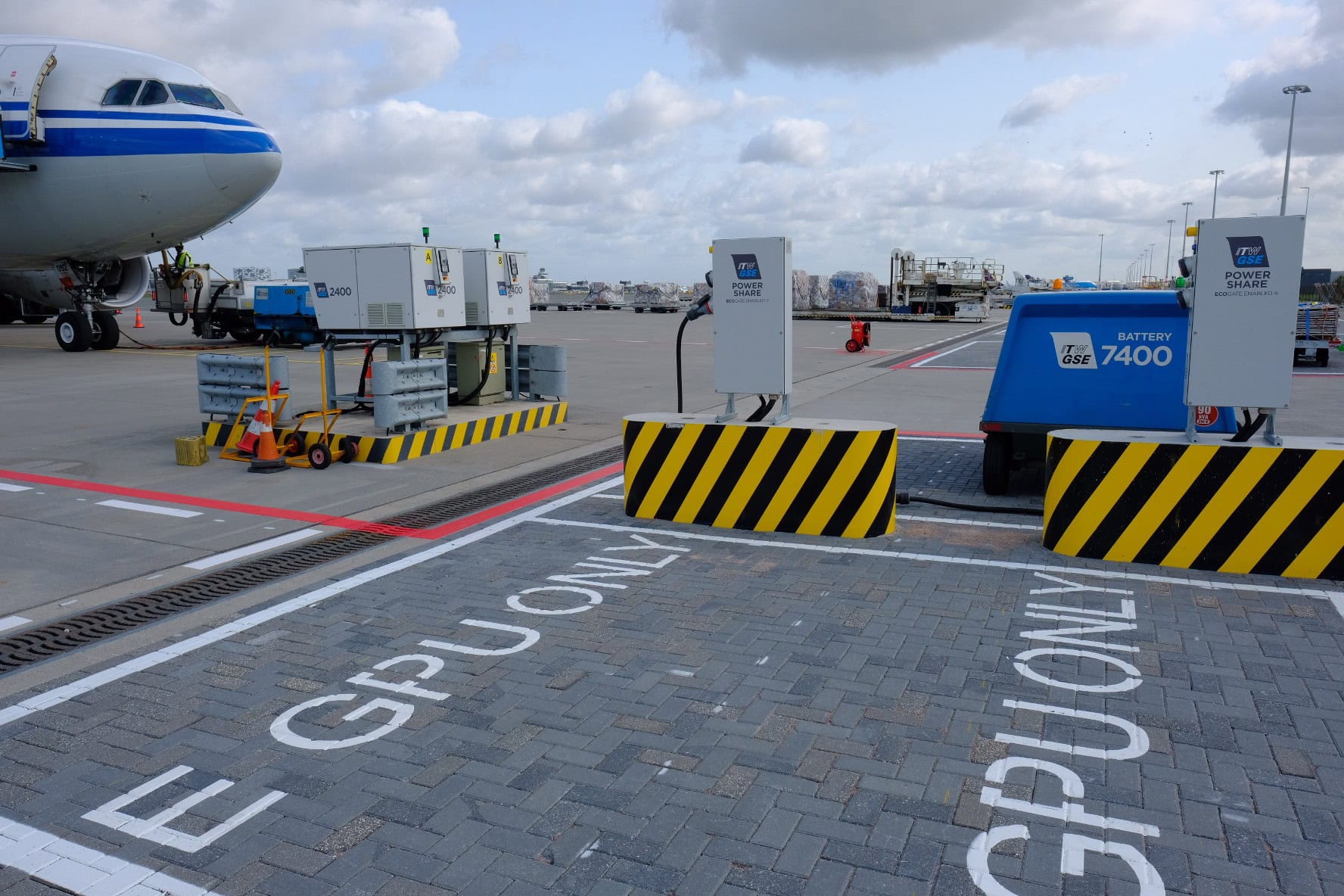
itw gse power share charger at the apron next to an aircraft and a 7400 battery driven ground power unit

Can existing infrastructure support charging and PCA simultaneously?

Yes, if power demand is coordinated. PCA and GPU should be prioritized during turnaround, while charging uses remaining available capacity and adjusts when aircraft-critical demand increases.

The solution is to align energy usage across systems, ensuring that:

  • Aircraft support (PCA, GPU) is always prioritized
  • Charging adapts to available capacity
  • Power is distributed based on real-time operational needs

When managed as a system, both functions can coexist within existing infrastructure.

How do we avoid power overload at the gate?

Power overload can be avoided by setting a maximum gate load and dynamically adjusting non-critical equipment, such as charging, when PCA or GPU demand increases.

To avoid this, airports need controlled power allocation, where:

  • Maximum load per gate is defined
  • Equipment consumption is dynamically adjusted
  • Non-critical loads are temporarily reduced if needed

This ensures stable operation — even in high-demand situations — and protects both infrastructure and equipment.

The article How EcoGate can ease charging challenges explains how EcoGate can help airports use surplus power and ease charging challenges.
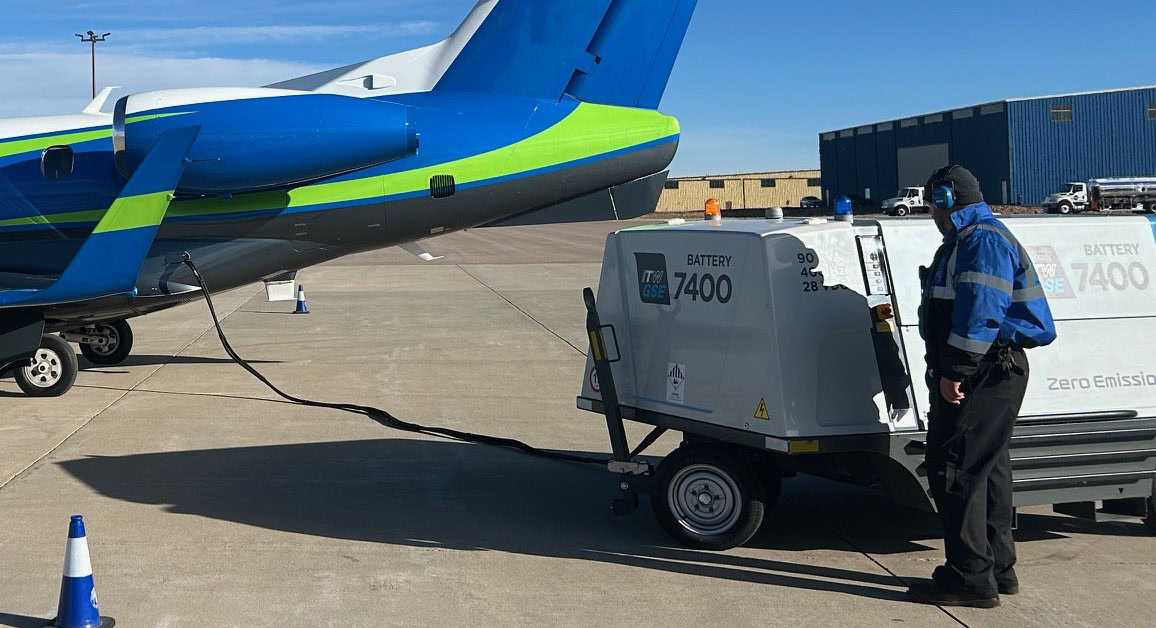
ITW GSE 7400 eGPU - Colorado, US

How can we electrify without upgrading infrastructure?

Electrification does not always require major infrastructure upgrades.

A common approach is to optimize existing gate-level power capacity before expanding the grid or upgrading infrastructure, by:

  • Sharing available power across equipment
  • Limiting peak load through intelligent control
  • Prioritizing aircraft-critical functions such as ground power and cooling

This allows airports to delay or reduce costly grid upgrades, while still progressing with electrification.

The ITW GSE Intelligent Power Management lets you coordinate power usage within existing grid constraints.

How do we prioritize power between aircraft and GSE?

Aircraft always come first when prioritizing power.

Ground Power Units (GPU) and PCA systems are critical for aircraft turnaround, passenger comfort, and APU reduction. GSE charging, on the other hand, is flexible.

Effective electrification strategies ensure that:

  • Aircraft systems receive guaranteed power
  • Charging is reduced or paused during peak demand
  • Available capacity is used efficiently across all connected equipment

This prioritization is key to maintaining operational reliability while scaling electrification.
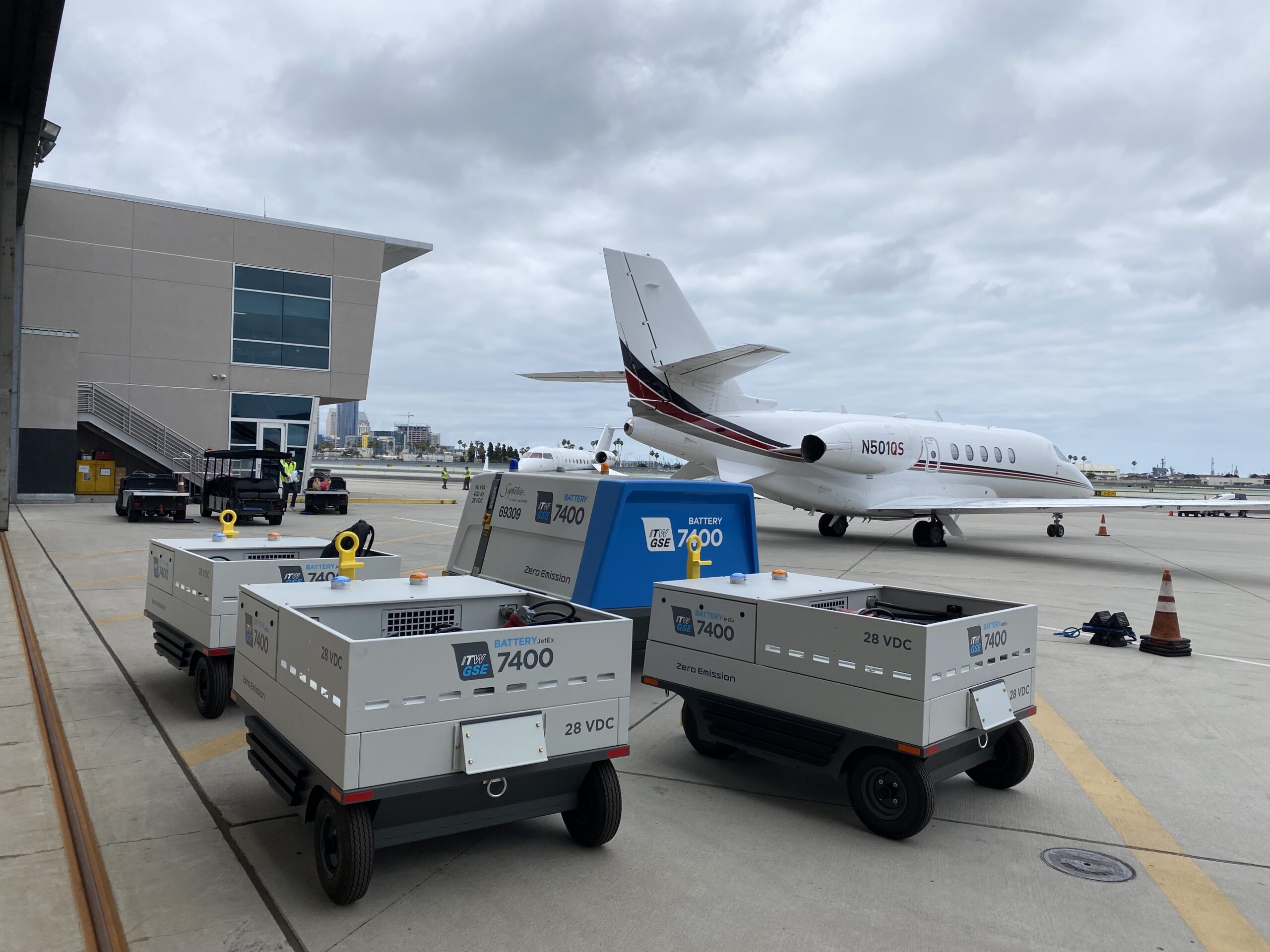
What is the best mix of fixed vs. mobile electric equipment?

Fixed equipment is best suited for contact gates with predictable demand, while mobile electric GSE adds flexibility for remote stands, irregular traffic and peak periods.
But of course, there is no such thing as 'one size fits all'.

In general:

  • Fixed equipment (e.g. GPUs, PCA units) provides stable, high-performance supply at contact gates
  • Mobile electric GSE adds flexibility for remote stands, where fixed gate infrastructure may not be available, and for peak demand situations.

What are the risks of going fully electric too fast?

The biggest risk is not electrification itself — but uncoordinated electrification.

Common challenges include:

  • Charging bottlenecks
  • Grid overload
  • Underutilized or competing equipment
  • Operational disruption during peak periods

A phased, system-based approach like EcoGate, reduces these risks by aligning infrastructure, operations, and equipment from the start.

If charging congestion is the main constraint, the article Charging bottlenecks aren’t about fleet size, they’re about system design explains how gate-level charging and coordinated system design can reduce operational pressure.
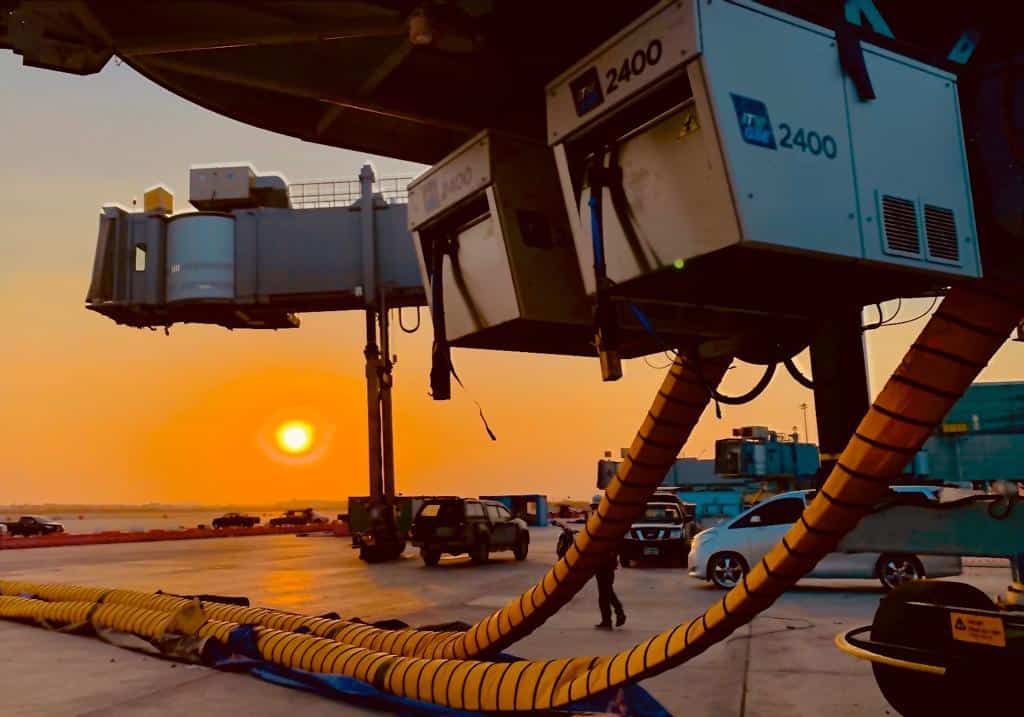
itwgse, itw gse, 2400 gpu, gpu airport, gpu airliner, gpu aircraft, ground power unit, 400 Hz, 400 Hz frequency converter

How do we ensure reliability of electric GSE in daily operations?

Reliability of the electric GSE depends on how all the equipment is integrated.

To ensure consistent performance:

  • Power availability must be predictable
  • Charging must fit operational workflows
  • Equipment must be easy to service and maintain
  • Systems must work together — not independently

Airports that treat electrification as an operational system, rather than a product upgrade, achieve higher uptime and smoother daily operations.

From standalone equipment to connected systems

Scaling electrification is not about adding more electric units. It’s about connecting them.

A system-based approach — where power, charging, and other equipment are coordinated — enables airports to:

  • Do more with existing infrastructure
  • Avoid bottlenecks and overload
  • Maintain reliable operations at scale
  • Progress toward decarbonization without disruption

This is where the industry is moving — from individual products to integrated gate ecosystems.

The EcoGate concept is our system approach, linking the various GSE units together.

ecogate dark image from itw gse

Plan your electric GSE setup with ITW GSE

Scaling electric GSE across multiple gates requires more than equipment selection. It requires a coordinated strategy for power, charging, PCA and daily operations.

Talk to our sales team about how ITW GSE can help you assess your biggest constraint and plan a scalable electrification setup.

Frequently Asked Questions

How do airports scale electric GSE across multiple gates?

Airports scale electric GSE by coordinating charging, GPU and PCA as one connected power system. This allows aircraft-critical functions to be prioritized while charging adapts to available capacity across gates. The EcoGate system coordinates the installed ITW GSE equipment.

Can airports electrify GSE without upgrading grid infrastructure?

In many cases, airports can delay or reduce grid upgrades by optimizing existing capacity first.

This includes load sharing, charging prioritization, opportunity charging and coordinated power management across gate equipment.

You can read more about electrifying without expanding here.

How can airports avoid charging bottlenecks?

Charging bottlenecks can be reduced by moving charging closer to operations, using opportunity charging and avoiding simultaneous peak demand.

Gate-level charging can also reduce queues and downtime.

You can read more about avoiding charging bottlenecks here.

How should power be prioritized between aircraft, PCA, GPU, and GSE charging?

Aircraft-critical systems should always come first.

GPU and PCA demand should be protected during turnaround, while GSE charging uses remaining capacity and can be reduced or paused during peak demand.

What is the role of EcoGate in airport electrification?

EcoGate supports a system-based approach where gate equipment, charging and power availability are coordinated. This helps airports use existing infrastructure more efficiently while scaling electric GSE.

What is the difference between fixed and mobile electric GSE?

Fixed equipment is typically suited for contact gates with predictable demand, while mobile electric GSE provides flexibility for remote stands, irregular operations and peak demand situations. Most airports need a balanced mix between the fixed and the mobile equipment.

You see both fixed and mobile GPUs here, and fixed and mobile PCAs here.